An important aspect of the Consortium's work is the creation
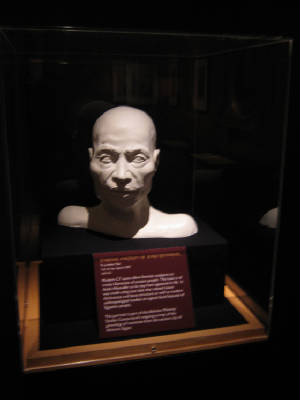
of the Community of Portraits using modern methods of forensic facial reconstruction and CT-based modeling. The Consortium
believes that such reconstructions provide clues to the ethnicity of the population associated with the city of Akhmim. Our
work allows us to explore the ethnic diversity of ancient Egypt more generally. We began working on the Community of Portraits
in 2005. Renowned forensic sculptor Frank Bender (1941-2011) produced our earliest portraits, four Ptolemaic females
and one Ptolemaic male. The Consortium later commissioned N. Eileen Barrow of the FACES Lab, Baton Rouge to produce three
other portraits, a Saite Period female, and two Ptolemaic males.
|
|
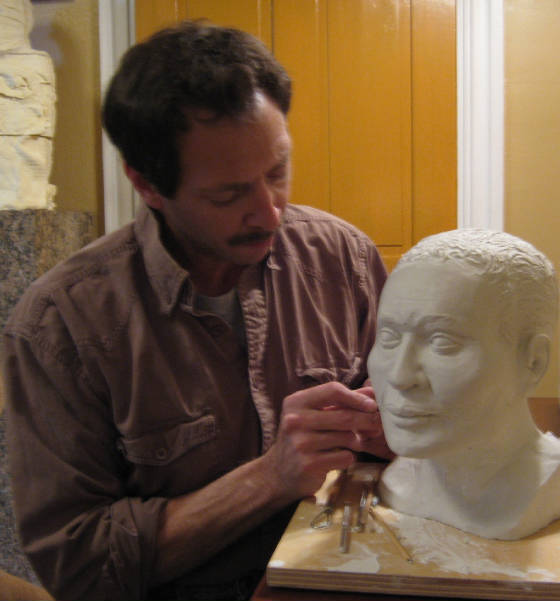
| Anthropologist J. P. Elias at work on Wehemefankh.�AMSCResearch 2012 All Rights Reserved |
The Community of Portraits continues to
grow through the efforts of Dr. Jonathan P. Elias, who has built upon the work of these sculptors, while attempting
to refine the methods of forensic facial reconstruction in relation to ancient Egyptian populations. As of this writing,
15 forensic facial reconstructions of ancient Egyptians have been completed. El-Mehallawi, I and
Soliman, E 2001. "Ultrasonic assessment of facial soft tissue thicknesses in adult Egyptians,"
Forensic Sci. Int., 117(1-2), 99-107.
Gill-Robinson, H, Elias J, Bender, F, Allard T. and Hoppa, R 2006. “Using Image Analysis Software to
Create a Physical Skull Model for the Facial Reconstruction of a Wrapped Akhmimic Mummy,” Journal of Computing and
Information Technology - CIT 14, 1, 45–51.
|
|
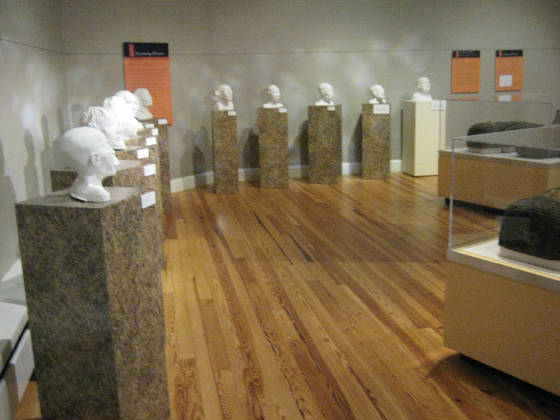
| The Community of Portraits, on exhibit at Berkshire Museum, Pittsfield, MA, June-October 2010 |
Inquiries on the "Community of Portraits"
Research on the Mummies of AkhmimResearch on the mummies of Akhmim began with the well-known autopsy of the mummy known as PUM II
(owned by the Philadelphia Museum of Art) transferred to the Pennsylvania University Museum for analysis by
a multidisciplinary team led by Aidan Cockburn in 1973. ... With the development of CT (computed tomography), the study of mummies was put on a new, non-invasive
footing. The dispersed mummies of Akhmim were a focal point of early CT research both in Hannover, Germany and in Milwaukee,
Wisconsin (USA). The Milwaukee project, spearheaded by Carter Lupton, formed the nucleus of the current, expanded project
of the Consortium. In 2005, the Consortium launched the Akhmim Mummy Project as an on-going and sustained effort
to understand the ancient population of Akhmim by means of CT-scans and other forms of analysis. The study of Egyptian mummies from Akhmim has provided an
important data set which has grown enormously, and is available for comparison with other Egyptian mummies. As of April
2011, the Consortium had performed or otherwise collaborated in CT scans on 23 mummies, and has assisted in a broad range
of other mummy related analyses and conservation endeavors. __________ Lupton,
C 2001. “An Historical Study of Two Egyptian Mummies in the Milwaukee Public Museum,”
In: Williams, E. ed, Human Remains: Conservation, retrieval and analysis, Proceedings of a conference held in Williamsburg,
Va, Nov. 7-11th, 1999. BAR International Series, 934, 215-225. ___________
Elias, J and Lupton, C 2005. “The Role of Computed Axial Tomography in the Study of the
Mummies of Akhmim, Egypt”. In Rabino-Massa, E. ed., Proceedings V World Congress on Mummy Studies. Journal
of Biological Research, LXXX, N. 1, 34-38. Elias, J and Lupton,
C 2008. “The Social Parameters of Mummification in Akhmim, Egypt (700-200 BC).” In Atoche,
P, Martin, C. & Rodriguez, M. eds. Mummies and Science. World Mummies Research (Proceedings of the VIth World
Congress on Mummy Studies, Teguise, Lanzarote, Canary Islands), 507-514.
Chan, S, Elias, J, Hysell, M, and Hallowell, M 2008. "CT of a
Ptolemaic Mummy from the Ancient Egyptian City of Akhmim,” Radiographics 28, 7 (Nov-Dec),
2023-2032.
|