|
|
 |
|
|
|
|
Mummy Discoveries Continuing Research on the Mummies of Akhmim By Jonathan P. Elias, Ph. D., Director, Akhmim Mummy Studies Consortium Mummies are a source of enduring fascination not only as sources of bioanthropological
information but in connection with the study of ancient Egyptian beliefs about resurrection and the technical means of achieving
eternal life. Research on Egyptian mummification is still in its infancy, but is rapidly improving through use of computed
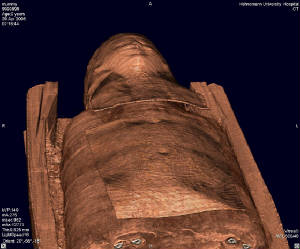
tomography (CT) on Ptolemaic mummies, and those of earlier periods. The mummy CT scan ("cat-scan") is a powerful
tool for new mummy discoveries and for achieving a new understanding about ancient Egyptian views of life and death. The scanning
process produces important data sets on ancient Egyptian people which are archived by the Akhmim Mummy Studies Consortium.
The Consortium is involved in ground-breaking forensic research on the ancient population of the Egyptian city of Akhmim/Panopolis)
as it existed during the Egyptian Saite Period (664-525 BC), Late Period (525-305 BC) and Ptolemaic Era (305-30 BC).
|
| CT Scan of a Ptolemaic Period mummy from Akhmim. �AMSCResearch 2011 All Rights Reserved. |
|
|
|
Evidence of Ancient Surgery Recent CT scanning by the Milwaukee Public Museum and the Akhmim Studies Consortium
detected unexpected evidence of trepanation in an Egyptian mummy dating to the Saite Period (664-525 BC). The mummy and his
inner coffin were discovered in the mid-1880's at Akhmim and were acquired by the Meinecke family of Milwaukee. The Meineckes donated
this mummy and another of Ptolemaic date (ca. 250 BC) to the Milwaukee Public Museum in 1887. This Saite mummy and his coffin are
today catalogued as MPM A10264. General analysis of the CT scan indicates that the mummy is that of a mature male,
at least 40-45 years old, who suffered from age-related periodontal problems in both upper and lower jaws (both abscessing
and bone resorption). The occlusal surfaces of the teeth show moderate to severe levels of dental attrition (enamel wear),
and the upper incisors are especially worn. The coffin containing this mummy is inscribed with the name “Djedhor, son
of Padiamun and Neshmet-Renenutet”. This Djedhor is titled “washerman of the wrapped (ones) of the house of Min,
Lord of Akhmim”; the term “washerman” refers to an important funerary specialist, and the house of Min is
the main city temple.
|
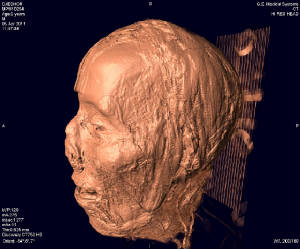
| The head of MPM A10264 "Djedhor" from Akhmim. �AMSCResearch 2011 All Rights Reserved. |
|
|
|
Original wrapping in direct
contact with the crown and sides of the head remains in situ, but bandages covering the face of the mummy have been
cut away by early investigators, and the outlying shroud is disturbed in the head area. Beneath the intact wrappings, the
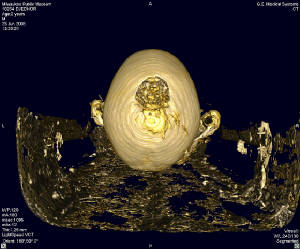
2006 scan revealed a large hole in the summit of MPM 10264’s cranium. Its specific form is a broad ellipse with semi-regular
margins measuring 53 mm (A-P) by 43.5 mm (R-L). It is aligned centrally behind the coronal suture in the sagittal plane, located
107.0 -111.0 mm behind the upper margin of the right and left orbits, respectively. The aperture was completely hidden by
overlying bandages supported by a small amount of textile wadding that had been inserted into the opening. In one or two areas,
the traces of circumferential borings may be apparent. The presence of eight to ten small holes, approximately 8 mm in diameter,
is noted. These represent a trepanation technique in which small holes were drilled circumferentially and then connected by
removing the interstitial bone tabs or separations between them.
|
| Trepanation surgery in the summit of Djedhor's skull. �AMSCResearch 2011 All Rights Reserved. |
|
|
|
We have suggested in an upcoming article (Elias et al. 2011) that the trepanation of the skull of this mummy was
performed in response to symptoms associated with a supraorbital abscess identified by Dr. Robert Yohe (University of California,
Bakersfield) in the upper wall of the left orbit communicating with the frontal sinus (Elias et al., 2009). Possible etiologies
for the lesion include: acute sinusitis, cellulitis and Cat Scratch Disease (all forms of bacterial infection having the potential
of spreading into an adjacent orbit and creating deposits of pus). Another possibility considered was Potts’ Puffy tumor
and other kinds of metastatic growths. Such conditions would likely have been accompanied by symptoms affecting the appearance
and function of the left eye including eyelid edema, proptosis (eye protrusion of non-endocrine origin), loss of visual acuity
and a general body temperature of at least 38° C (100.4 °F). In theory, trepanation would have
addressed these symptoms in a meaningful way. __ Elias, J., Lupton, C., Yohe, R. and Hoppa, R. 2009. Getting the Hole Picture: Possible
Trepanation in Response to Sinus Infection as seen in an Akhmimic Mummy, Poster, 36th Annual Meeting of the Paleopathology
Association Chicago, Illinois, March 31 – April 1. ...
Elias,
J., Lupton, C., and Hoppa R. 2011. Evidence of Trepanation in a 26th Dynasty Mummy from Akhmim, Egypt. Poster, 7th World Congress
on Mummy Studies, San Diego,California, June 12-June 16. ...
|
|
|
Elias, J., Lupton, C., Yohe, R. and Hoppa,
R. 2009. Getting the Hole Picture: Possible Trepanation in Response to Sinus Infection as seen in an Akhmimic Mummy, Poster,
36th Annual Meeting of the Paleopathology Association Chicago, Illinois, March 31 – April 1. --- __ Elias,
J., Lupton, C., and Hoppa R. 2011. Evidence of Trepanation in a 26th Dynasty Mummy from Akhmim,
Egypt. Poster, 7th World Congress on Mummy Studies, San Diego,California, June 12-June 16.
Elias, J., Lupton, C., Yohe, R. and Hoppa, R. 2009. Getting the Hole Picture: Possible Trepanation in Response to Sinus
Infection as seen in an Akhmimic Mummy, Poster, 36th Annual Meeting of the Paleopathology Association Chicago, Illinois,
March 31 – April 1.Elias, J., Lupton, C., and Hoppa R. 2011. Evidence of Trepanation
in a 26th Dynasty Mummy from Akhmim, Egypt. Poster, 7th World Congress on Mummy Studies, San
Diego,California, June 12-June 16.
Elias, J., Lupton, C., Yohe, R. and Hoppa,
R. 2009. Getting the Hole Picture: Possible Trepanation in Response to Sinus Infection as seen in an Akhmimic Mummy, Poster,
36th Annual Meeting of the Paleopathology Association Chicago, Illinois, March 31 – April 1.
Elias, J., Lupton, C., and Hoppa R. 2011. Evidence of Trepanation in a 26th
Dynasty Mummy from Akhmim, Egypt. Poster, 7th World Congress on Mummy Studies, San Diego,California, June
12-June 16.
Elias, J., Lupton, C., Yohe, R. and Hoppa, R. 2009. Getting the Hole Picture: Possible Trepanation in Response to Sinus
Infection as seen in an Akhmimic Mummy, Poster, 36th Annual Meeting of the Paleopathology Association Chicago, Illinois,
March 31 – April 1.
|
|
|
|